










































Infodemic Management Using Digital Information and Knowledge Cocreation to Address COVID-19 Vaccine Hesitancy: Case Study From Ghana
UNICEF Ghana Country Office (Lohiniva, Nurzhynska, Hudi); Ghana Health Service (Anim, Aboagye)
"The system has been used to identify COVID-19 misinformation, disinformation, and rumors, which were addressed in a timely manner."
A number of studies have highlighted the negative effects of the so-called COVID-19 "infodemic" on public perceptions of the pandemic and reluctance to comply with public health guidance, including willingness to accept a COVID-19 vaccine. In response, Ghana Health Service (GHS) together with the United Nations Children's Fund (UNICEF) Ghana Country Office developed a systematic process to identify, analyse, and respond to COVID-19 and vaccine-related misinformation in Ghana. This paper describes the methodology of the infodemic management system in Ghana, which combines digital and human-centred approaches. Some concrete examples are also given to demonstrate how infodemic management operates. The findings of the study can be used to apply the system in other countries that plan to conduct social listening.
As outlined here, in March 2021, Ghana received COVID-19 vaccines from the COVAX facility. However, by the beginning of 2022, less than half of the intended population of 20 million people had received at least one vaccine dose, and only about 13% were fully vaccinated. Surveys indicated that the hesitancy is fueled by different factors that change over time, such as the fear of side effects and the lack of trust in the vaccines. Similar to many other countries, Ghana has witnessed the widespread transmission of misinformation during the pandemic on the web and offline, including the period during promotion of COVID-19 vaccines.
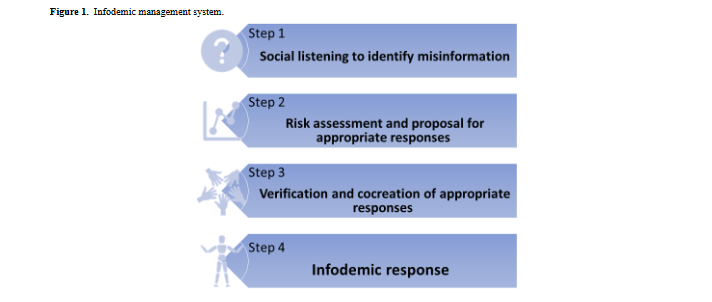
The infodemic management system was developed by the Health Promotion Division of the GHS and the UNICEF Country Office. It uses Talkwalker, a commercial social listening software platform, to collect misinformation on the web. As part of this platform, machine learning and artificial intelligence consolidate publicly visible occurrences of given keywords on the internet. Talkwalker functions like a search engine and provides the ability to filter, contextualise, export, and analyse large data sets.
A multi-sectoral National Misinformation Task Force was established to implement and oversee the misinformation management system. Two members of the task force use Talkwalker to find posts that include keywords related to COVID-19-vaccine-related discussions. The team then assesses the significance of the posts on the basis of the engagement rate and potential reach of the posts, negative sentiments, and contextual factors. The process continues by identifying misinformation within the posts, rating the risk of identified misinformation posts, and developing proposed responses to address them. The results of the analysis are shared weekly with the entire task force for their review and verification.
In this way, the methodology relies on knowledge cocreation, which is referred to as collaborative knowledge generation by various stakeholders. Knowledge cocreation is a participatory approach to enhance the value and reliability of outcomes and ensure they benefit all parties. The Misinformation Management Task Force cocreates by assessing the risk level and the proposed responses to address misinformation to ensure they are feasible, practical, and acceptable in the context of Ghana. Responses may include press releases, social media posts, and direct communication, among others. The GHS is responsible for implementing the response.
The article provides 4 examples of implementing the misinformation management workflow: negative attitude of healthcare workers; misinformation about the side effects of COVID-19 vaccines; disinformation about the alleged lethal nature of the COVID-19 vaccine; and mistrust toward the COVID-19 vaccination programme and health authorities.
In reflecting on the system, the researchers point to:
- The critical role of qualitative inquiry in social listening, "as it allows for a greater understanding of the positions, perceptions, and potential misinformation and disinformation among population groups in order to assess the potential risk and take appropriate action in a timely and targeted manner. For example, a post from a football coach may not be significant in a country where football is less popular, but in the context of Ghana, it was assessed as a high risk that has the potential to spread fast and raise high emotions. Talkwalker cannot carry out such an interpretation, which aligns with a number of studies that have pointed out the limitations of machines."
- The fact that "knowledge cocreation can be implemented even in crisis situations....The Misinformation Task Force was developed by merging an existing working group with the task force instead of creating a new structure..." As noted here: "Ideally, cocreation will allow the task force members to build their misinformation management skills so that in the future, the system can run without support from external stakeholders such as UNICEF."
- The limitations of infodemic management system in Ghana. For example: "The Talkwalker posts and interactions are mainly published by men and young adults, excluding the voices of women, youth, and older people. In addition, [t]here are still significant numbers of people, particularly in vulnerable populations such as low-income individuals and those who cannot read and write, who are not reached by digital platforms....Cocreation methods can mitigate bias....Other strategies to minimize bias should be considered, such as engaging more task force members with different backgrounds in the assessment and analysis process..."
In conclusion: "Infodemic management benefits from human-centered approaches that encourage knowledge sharing and knowledge cocreation....[T]he bidirectional, interactive development of new knowledge created with input and perspectives from diverse stakeholders...allows for the development of acceptable and practical interventions that can be better sustained than those that are developed by public health experts alone..."
JMIR Infodemiology 2022;2(2):e37134) doi: 10.2196/37134.
- Log in to post comments