










































Edutainment Radio, Women's Status and Primary School Participation: Evidence from Cambodia
Stockholm University
This paper investigates whether exposure to "edutainment" (education/entertainment) radio leads to improved women's status and primary school participation. Specifically, the author examines a popular radio station focusing on gender issues in Cambodia, the Women's Station FM 102. The author notes that "[m]ost of the literature on edutainment interventions is found within the sociological field using more descriptive data. This is an attempt to establish a causal relationship using quantitative empirical methods on a country-wide dataset."
As detailed here, the mission of Women's Station FM 102 is to educate and inform Cambodians about various social and women's issues - women's rights and health, domestic violence, HIV/AIDS awareness, tracking, elections, decentralisation, and poverty alleviation - by designing and implementing edutainment programmes. Owned and operated by the WMC, a donor-driven, non-profit and local non-governmental organisation (NGO), Women's Station FM 102 broadcasts daily programmes that consist of live and self-produced shows, daily news bulletins, and international news from the Australian Broadcasting Corporation service. In general, all their programmes are designed based on an edutainment strategy whereby the educational information is made more interesting by weaving it together with entertainment such as music, comedy, dramas, etc.
An example of a past edutainment Women's Station FM 102 programme was the call-in show for young people, called "Os Tos Mhong!" (Cool) and broadcast live every Sunday morning in 2004, presented by two youth sharing their own experiences. The programme format included talk shows, information, advice, music, and competition; the communication strategy was to create a safe but lively and entertaining space to question, share ideas, and voice opinions. Young people were encouraged to actively share their views with other listeners live on air as well as through emails and letters. In addition to entertainment, the show provided educational information about a particular topic such as youth culture, music, gender equality, education, etc. (Each week had its particular focus.)
To identify the effect that Women's Station FM 102 might have had on women's empowerment, the author used 2 complementary identification strategies. The first one exploits the within-district variation in over-the-air signal strength, while the second one uses variation across time and space, exploiting the fact that the radio coverage was gradually expanded over time and across regions. Recognising the multifaceted nature of women's status, she used several indicators, including the degree of son preference, women's attitude towards wife beating, and their degree of participating in household decision-making, including having the sole/final say in decisions regarding the children's schooling. To estimate the effect on children's school participation, she used school attendance for children aged 6-12 as well as enrollment records for grade 1-6.
Using individual data, both approaches show that the exposure had a significant impact on behaviour by raising the women's decision-making power within the household and increasing children's primary school attendance. The impact was found in both economically poor and rural households, confirming that radio is an effective vehicle to transmit information in the more marginalised areas.
"This is because pure didactic interventions or programs are usually incapable to retain the audiences' interest, even if well produced, and could thus successfully be accompanied by an edutainment strategy as part of an overall development communication approach....In relation to changing gender related attitudes, convincing households to invest in children's schooling might be an easier task by enlightening the society about the importance of schooling for their future accumulated earnings. But trying to make structural adjustments by changing gender related attitudes in a society that is characterized by a patriarchal system might take a much longer time." The latter reflects the author's finding of only suggestive evidence that exposure to edutainment radio had affected attitudes towards domestic violence and the degree of son preference, implying that it might be more difficult to change structural inequalities, particularly in societies where gender discrimination is enforced by social norms. However, the author concludes that the evidence that the exposure affected attitudes towards domestic violence and the prevalence of son preference, albeit only suggestive, is a stepping stone towards changing socially constructed gender norms.
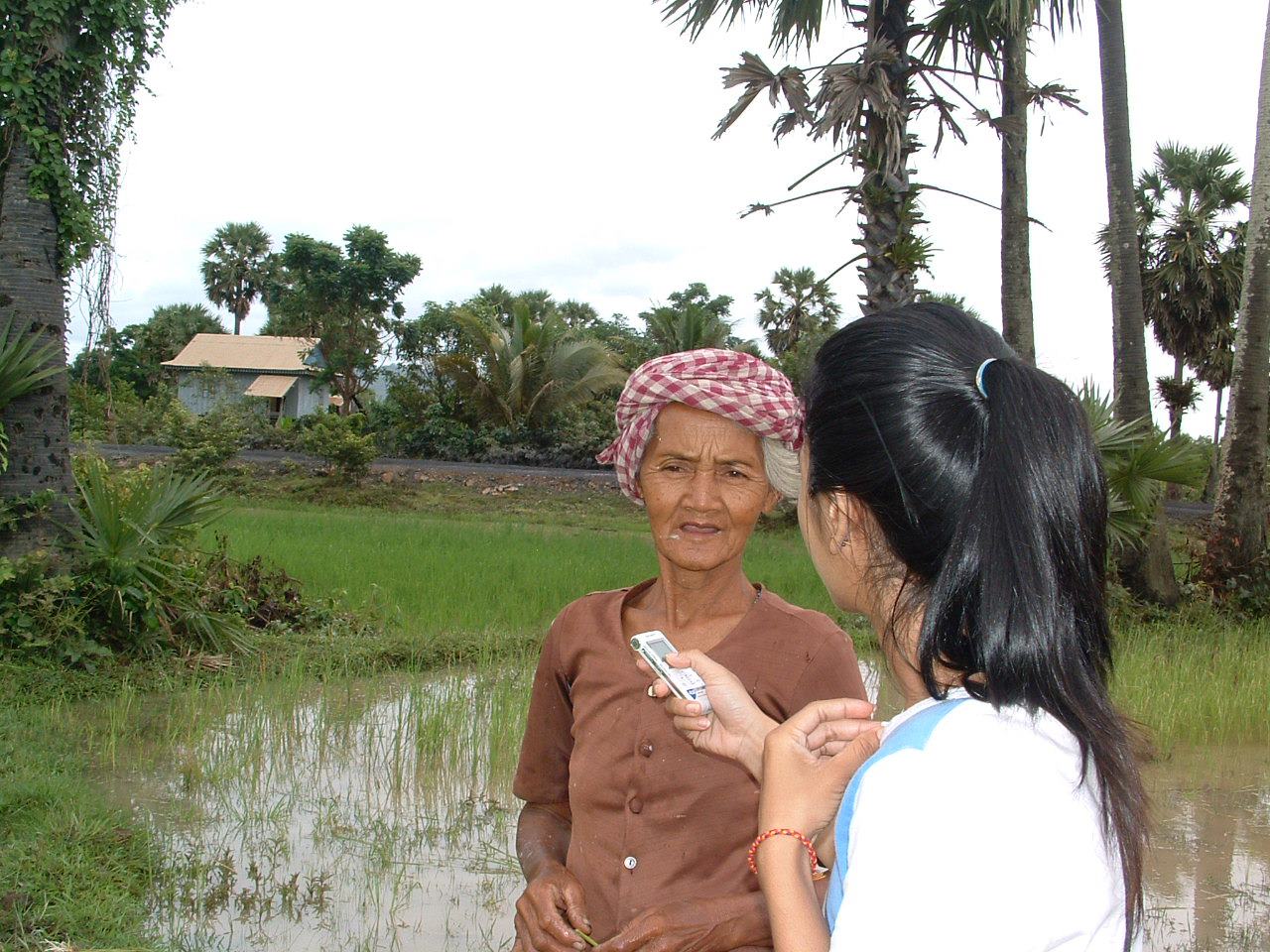
Email from Maria Cheung to The Communication Initiative on May 20 2013. Image Credit: Strey Khmer
- Log in to post comments